
This article is intended to summarize the HydroPoint valve decoder perception issue and ensure our external messaging is consistent.
Situation Overview
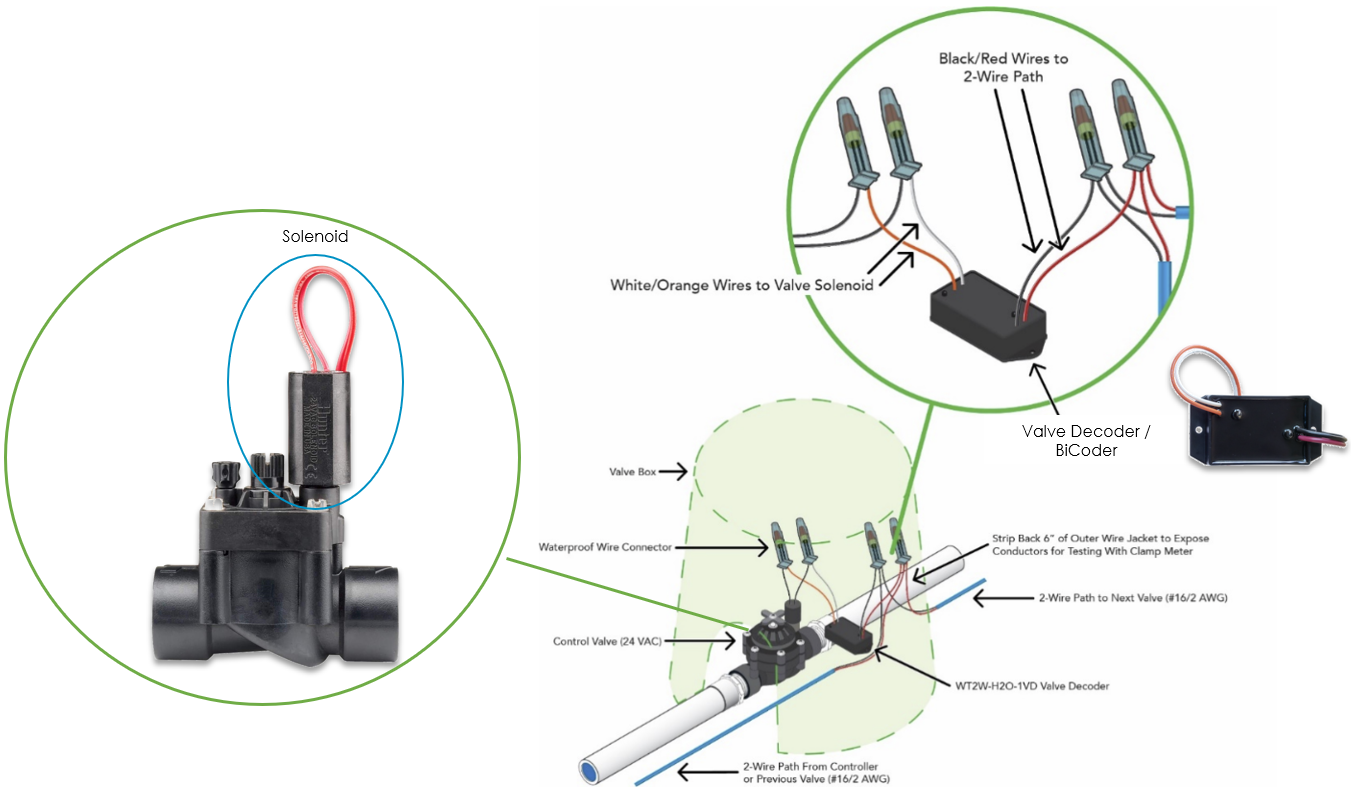
What is a Solenoid? An irrigation solenoid is an electronic plunger or coil that attaches to the control/master valve (see image above) and uses current to open and close the pilot hole within the control valve, regulating the flow of water to the sprinklers. Irrigation valve solenoids get wired to our decoders so they can talk to our controllers. Solenoids typically last 5 - 7 years. A broken solenoid requires the customer to purchase/install a replacement solenoid to resume water flow to the control valves stations (groups of like sprinklers). Early failures, diagnosis, downtime, and repair time can be both frustrating and costly for the customer.
Why Solenoids Fail
The market has experienced a marginal number of valve solenoids failing prematurely. In nearly all cases, solenoids fail prematurely as a result of bad splicing that occurs at the time of installation. Bad wire splices result in wire that is exposed to oxidation/ water, and subsequently susceptible to accelerated corrosion, open circuits, and shorts. A bad splice can lead to:
- Exposed wire with any presence of moisture could have water act as a conduit in the wire, rapidly increasing the current and causing a short (over current) to be drawn into the solenoid.
- Exposed wire that's severely corroded will increase the resistance in the wire, meaning the solenoid could receive too much current (short) if the bad splice is located after the solenoid in the wire path or too little current (open circuit) if bad splice before it.
- Exposed wire may have a path to ground (touches dirt, even sometimes the dielectric gel) allowing there to be an open circuit where current continuously passes through the solenoid, maturing it.
Rate of degradation will depend on how long station runs while wet (could resume normal operation once dried), extent of corrosion, number of stations running concurrently, etc. The takeaway is bad splices cause an ensemble of issues that lead to the system eventually failing sooner than expected.
When/How Bad Splices Occur
A bad splice may occur at the:
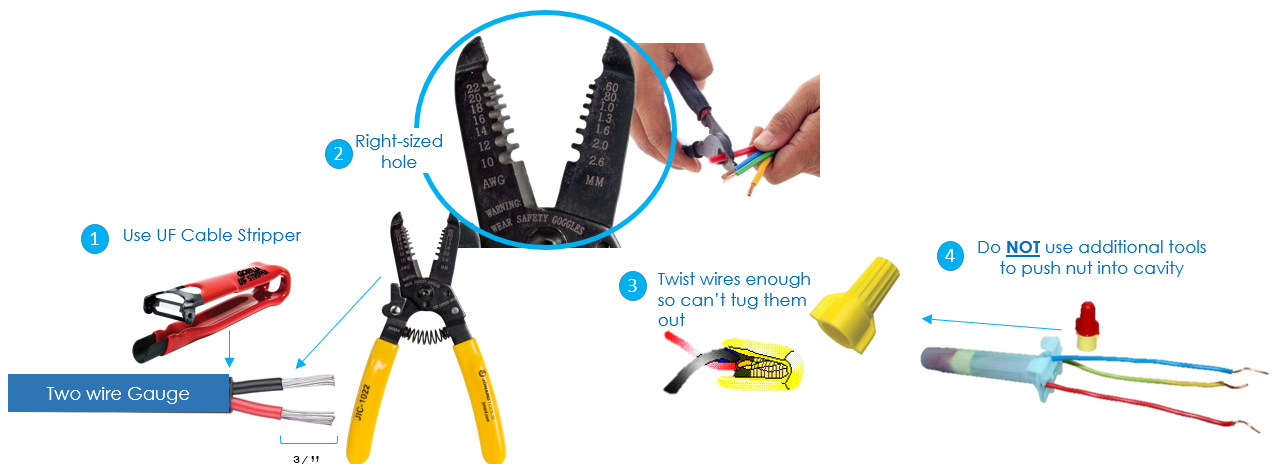
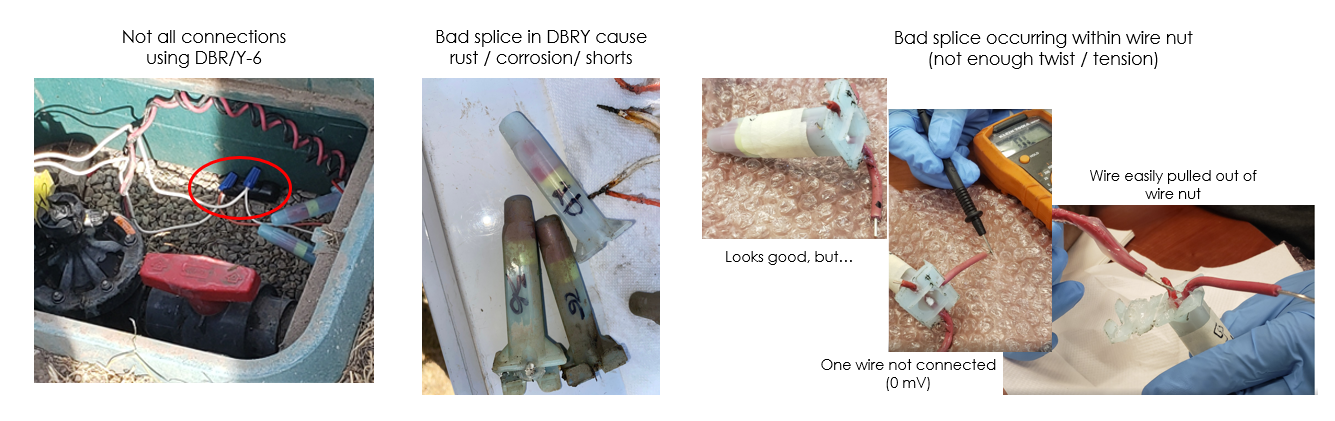
- Outer Sheath If did not use a UF cable stripper, ‘Potatoe peeler,’ to remove the two-wire gauge's sheath (outer jacket), the knife could cut into wire insulation or nick the wire itself.
- Inner Jacket If used the wrong sized hole on the wire stripper to remove the PVC insulation, the wire itself could be cut. If more than ¾" of insulation was stripped back, some wire could stick out of the nut.
- Wire Nut If did not twist the wires enough in the wire nut. To check if wires are twisted tightly enough in the nut, L/M/C should slightly tug on to verify they cannot easily be pulled out (Note: if twisted too tensely the wire copper may break).
- DBR/Y-6 Connector If used additional tool (screwdriver) to pushHydroPoint's nut into the end of the DBR/Y pocket, then a cavity could be created in the dielectric grease to allow water to get in. Also if not all connections used the DBR/Y-6
- For better understanding, watch Two-Wire Splices - YouTube
Other reasons can be read at Troubleshooting and Clearing Valve Alerts - HydroPoint (helpjuice.com)
What are the rumors competitors circulated?
Competitors in the market have circulated a narrative that HydroPoint's valve decoders/bicoders are causing premature solenoid failures. This narrative is false. The leading rumor has been that our decoders may leak voltage to the solenoid, causing it to prematurely fail. It should be noted that any electrical system has the potential for some voltage leak to occur. Volt leak will only accelerate degradation of the solenoid if there is a path to ground, which is only possible when there is a bad splice on the wire path. If exposed wire touches earth, forming a path to ground, then current could continue to pass through the solenoid to earth, wearing it out faster. If the wires were connected properly, then the circuit would be closed.
Our engineering investigations have also found a common theme for solenoid failures regardless of the irrigation controller manufacturer: most of the failures occurred in solenoids with bare copper wire instead of tinned wires. In wet/ contaminated environments, bare copper will oxidize more quickly, weakening bonds of the metal. For underground systems, it is industry best practice to use tinned wires to protect against oxidation and corrosion.
When installed correctly and to specification, HydroPoint's decoders provide optimal system performance. To help mitigate wire connection issues, we changed our valve decoders to use 16 gauge solid-core wire instead of 18-gauge stranded wire (Oct. 2023). The rigidity of the solid core wire makes it easier for installers to twist the wires into the nut and push the nut in to the end of DBRY capsule to get that critical water-tight seal. An additional Field-Effect Transistor (FET) was also added to the Single Decoder (Dual and Quad decoders already included this / weren't having solenoid issues) to serve as an extra disconnect in the circuit board, reducing the possibility of current leakage and adding protection in the decoder to not draw too much current when there's a presence of compromised wiring.
When installed correctly and to specification, HydroPoint's decoders provide optimal system performance. To help mitigate wire connection issues, we changed our valve decoders to use 16 gauge solid-core wire instead of 18-gauge stranded wire (Oct. 2023). The rigidity of the solid core wire makes it easier for installers to twist the wires into the nut and push the nut in to the end of DBRY capsule to get that critical water-tight seal. An additional Field-Effect Transistor (FET) was also added to the Single Decoder (Dual and Quad decoders already included this / weren't having solenoid issues) to serve as an extra disconnect in the circuit board, reducing the possibility of current leakage and adding protection in the decoder to not draw too much current when there's a presence of compromised wiring.
- Single Decoders with the added FET will have FW 6.3. Serial number for new decoder is D168001
- Baseline decoders with a serial number starting “Q00000” will be the upgraded version.
- WeatherTRAK decoders with a serial number starting at “H10000” will be the upgraded version.
Can a Baseline Valve biCoder Damage a Solenoid?
No. There is no way a biCoder can cause a solenoid to "burn up" prematurely. Our decoders do not apply enough electricity to burn up valve solenoids.
As part of the solenoid testing and development, Baseline connected a significant sample of valve biCoders in 1, 2, and 4 station configurations to various solenoids. We then simulated 80 years of normal usage by switching them on and off in one-minute duty cycles for a six-month period. The resistance and the current used to actuate each solenoid was monitored during the test period. The test demonstrated that the resistance and the current for the solenoids remained consistent, and all solenoids functioned correctly through the entire test.
The total current passing through a solenoid controlled by a Baseline biCoder is only 120 milliamps, which is much less than the 250 milliamps of current drawn by solenoids on a conventional wire system. The power dissipated in the solenoid is equal to the current through the solenoid squared multiplied by the resistance.
For example, on a conventional wire system, 250 milliamps x 26 Ohms = 1.62 watts.
The same solenoid driven by a Baseline biCoder is 120 milliamps x 26 Ohms = 0.41 watts, which is only 25% of the power drawn by the conventional wire system.
In fact, if you were to feel the temperature of two solenoids that had been powered for a long period of time, one connected to a conventional wire system and the other connected to a Baseline biCoder, the solenoid powered by the Baseline biCoder would feel cooler.
If you are experiencing failure on a solenoid that is connected to a Baseline biCoder, the failure is not being caused by the Baseline system. More likely, there is some mechanical or other types of failure occurring in the solenoid itself caused by something like water incursion.
Approved External Communication
Reported Solenoid Issues - Reasons for Premature Failures
Dear customer,
Thank you for being a great partner and working so closely with us. It has come to our attention there have been some reported issues with solenoids operating in Baseline two-wire systems in your market. As you can imagine, your concerns were very important for us to investigate. We would like to confirm the architecture of our two-wire system does not cause premature failures in valve solenoids. HydroPoint currently has hundreds of thousands of valve decoders successfully installed and optimally operating coast-to-coast.
Our engineering investigations over the course of the last 12 months - which include multiple site visits - has found the root cause of early solenoid failures to be improperly sealed wire connections occurring at the time of installation. Connections that expose wire will lead to accelerated corrosion, oxidation, pathways for water to get in and potentially a path to ground. We've been told the possibility of voltage leaking from the decoder to the solenoid - which is a possibility for all wired systems - is causing the solenoid to fail sooner. This only presents an increased risk if a bad splice is present and there is a path to ground. The path to ground, from the splice, creates an open circuit allowing current to either build up or continuously pass through the solenoid, aging it more quickly. Our investigation found, aside from improper installation practices, the higher predictor for premature solenoid failures, regardless of irrigation controller manufacturer, to be solenoids using bare copper wire instead of tinned wires. It is industry best practice to use tinned wires in irrigation applications (wet/contaminated environments) as bare cooper oxidizes more easily than tinned. We discovered that one large solenoid manufacturer converted to bare copper wire which may relate to the recent uptick in premature solenoid failures.
We have customarily included a pack of the best-of-breed 3M DBR/Y-6 gel connectors with every decoder we sell to ensure wire-tight seals. Make sure to use this in every connection between the two wire, decoder and solenoid valve. To further help mitigate wire connection issues, we enhanced our valve decoders to use 16 gauge solid-core wire instead of 18-gauge stranded wire. The rigidity of the solid-core wire will make it easier for the installer to twist the wires in the nut to ensure they do not fall out, as well as make it easier to push the wire-nut into the end of the DBRY connector. Do not use additional tools to push the wire nut into the DBRY capsule as this will create a cavity in the dielectric grease, deforming the seal. An additional FET was also added to the Single Decoders, which Dual and Quad decoders already included, to reduce the possibility of current leakage when a compromised wiring is present. This FET also serves as a protective disconnect for our decoders to not draw too much current.
It is likely our decoders are still fully operational regardless of a bad splice or failing solenoid, meaning replacements are unnecessary. Once the new solenoid is installed to spec, the system should resume normal operation. If you want to ensure best installation practices, read the attached leaflet or watch “Checking my Wire Connections” on our HydroPoint YouTube channel. We are happy to sit down to discuss any further questions you might have.
If you are aware of any issues with an installed HydroPoint valve decoder, please contact Support.
Thank you!
Bob Beers
Senior Product Manager, Smart Irrigation Technology, HydroPoint
208-639-8378 | bbeers@hydropoint.com
HydroPoint Customer Support
1 (800) 326-8774
Support Hours
Mon - Fri 5:00am - 5:00pm PT
Sat 9:00am - 2:00 pm PT
Policy to Replace Decoder
Improperly installed wire connections are out-of-spec and not covered by our warranty. Note: If the customer is requesting
- < 5 decoder replacements, Sales has discretion to provide free replacements should their circumstances qualify.
- ≥ 5 decoders, escalate the request to Charles Zaher/ Chris Manchuck for WeatherTrak or Chris Manchuck/ Chris Wright for Baseline.
Customer Support Instructions
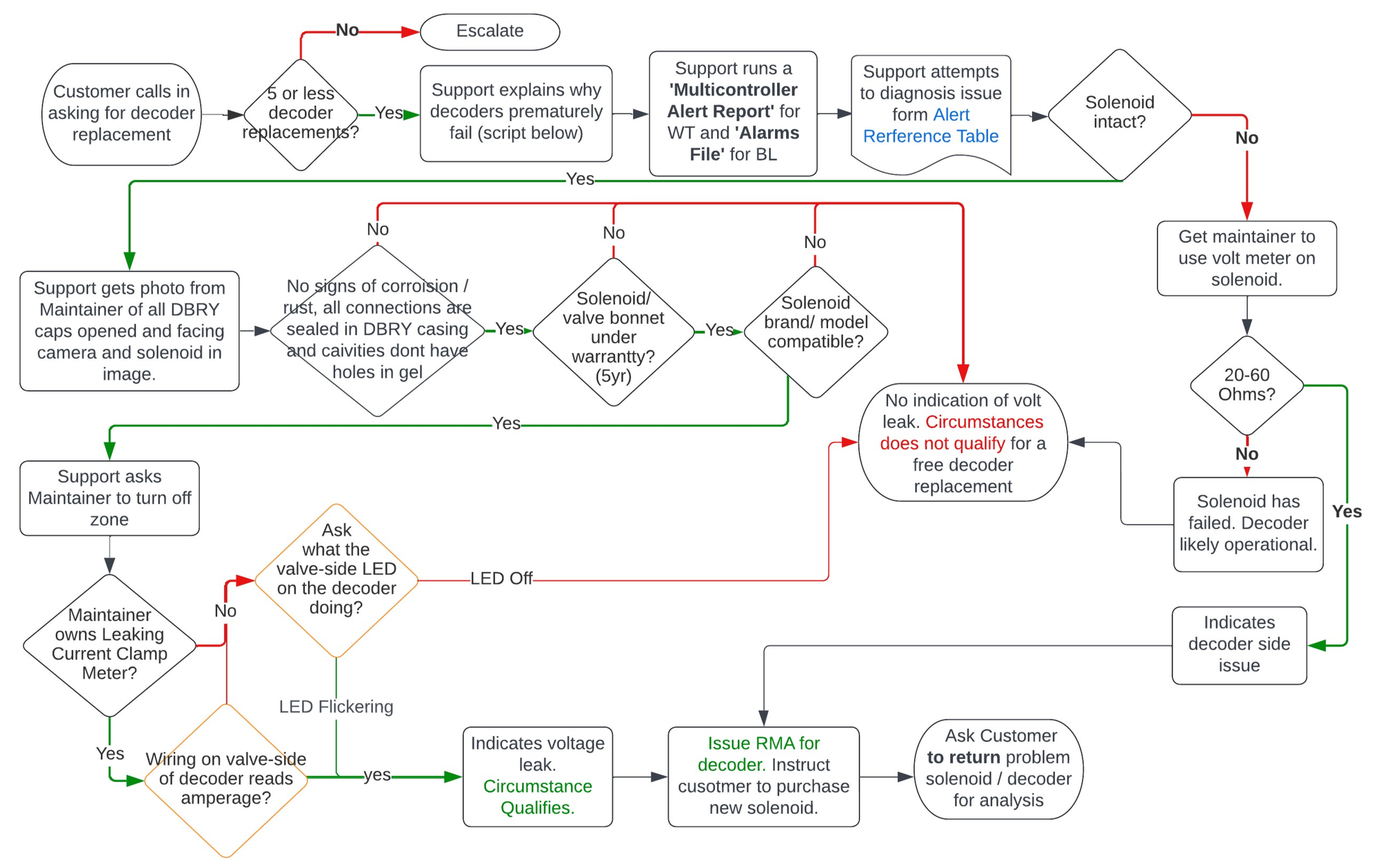
Please put the customer on hold to read all the entire page including the process steps/ approved messaging prior to speaking with the customer. There have been cases solenoids failed but decoders were mis-diagnosed as failed, but actually operable. Due diligence in troubleshooting is very important.
Steps to check:
- 5 or more replacements - escalate. Under 5 proceed
- Explain to customer the issue using 'Approved Messaging' below.
- Confirm Solenoid is intact. If the solenoid has been removed a report will show similar messages as a result of the missing part. Assume maintainer would not remove a good solenoid. If the Solenoid is removed, ask the maintainer to check its volt reading on it. If reading is between 20-60 ohms the solenoid is not damaged and we will need to replace decoder (if in warranty). If intact, leave it and proceed.
- The customer can run some diagnostic tests from the controller. Send the customer this public product document - Two Wire Troubleshooting & Diagnostic Guide - to get the station's (a) power, current and voltage readings (b) find out which alerts are being triggered from test © have user gain decoder knowledge including similar but separate possible issues (ex: two wire path issue).
- Send a photo of the system. Look for splicing integrity! Picture needs to have all DBRY caps open to see gel inside. Look for cracks in solenoid/ decoder casing, exposed/bare wire, or signs of corrosion/ rust. Check all connections have DBRY connector on them, see if any have openings/ cavities in gel where wire nut is. Be sure to upload photos in Salesforce Case History as point of evidence.
- Run an Alert Report. Remotely confirm [x] number of failed solenoids. Run a Multi-Controller Alert Report in wt.net or search for alerts in Quickview of Basemanager for BL (Alerts will be color-coded RED). If no related alerts, then we cannot send out free decoder replacements without evidence of failed solenoids. Remember this could be a two wire path issue . if you are confused consult Tier 2 or Tier 3.
How to Interpret Alarm by Product
If Baseline
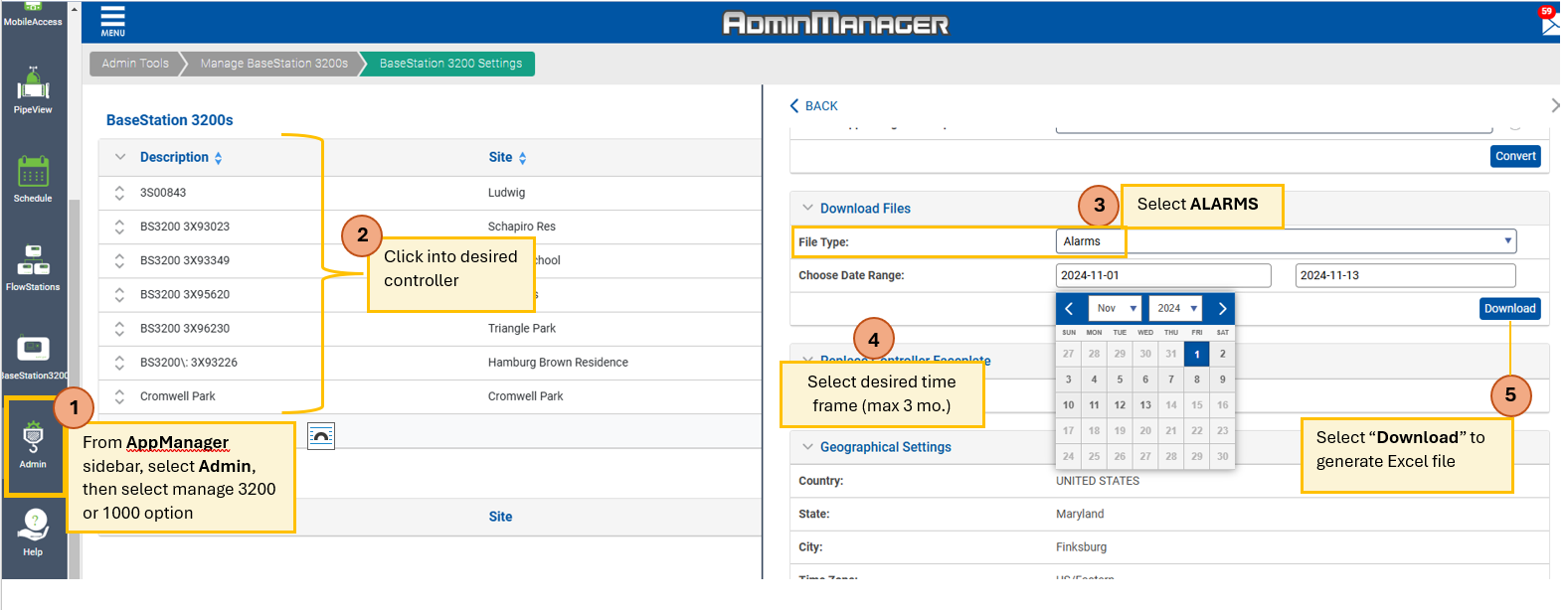
- go to App Manager, select controller, for file type select Alarms. Run in excel then search for “SC” in column G or ‘Short Circuit’ in column e to confirm there is in fact a Short Circuit Alert at that zone.
- SC Alert mean the decoder is issuing too much amperage and qualifies for replacement (high current).
- OC (open circuit) or NR (no response) Alerts does not qualify. OC implies severe resistance in splice (wires not touching or corrosion) and solenoid not drawing enough current to operate. NR is issue on the two-wire path, not near valve.
If WeatherTrak,
- run Multi Controller Alert Reports.
- the interpretation of alerts from Pro3H20 Controllers change depending on Firmware type.
- if Firmware 8.7 or below, you will not be able to determine if this failure is on the decoder, two-wire path or solenoid side. Proceed with troubleshoot process
- if Firmware 8.9 or above,
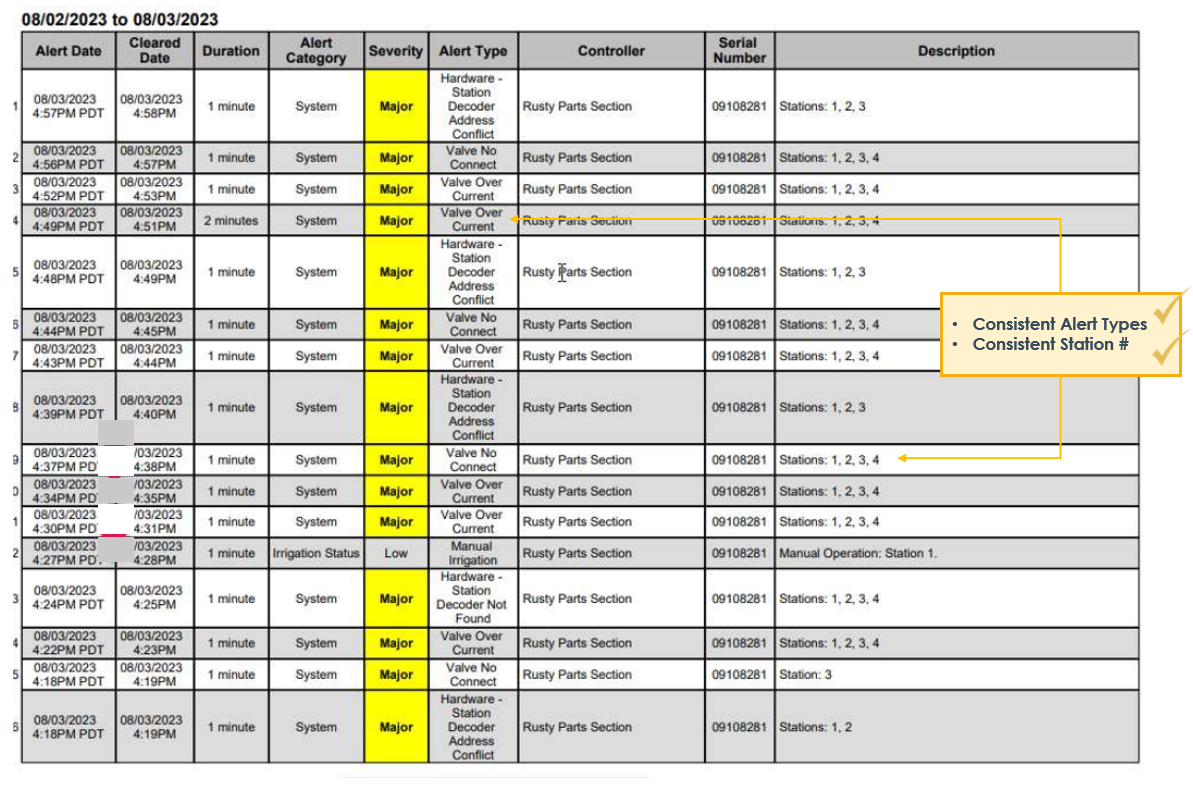
- ‘SH’ is Valve Short, and ‘NC’ is No Connect.
- If report shows the same stations are consistently showing these alerts, indicates issue is solenoid-side = qualifies.
- If report shows inconsistent stations with the errors or there are multiple alert types, then two-wire path issue = does not qualify
- ‘DM’ is Decoder Missing. Decoder-side issue, it is not communicating to the chassis = qualifies.
- ‘OC’ is Over Current. This is a two-wire path issue = does not qualify. Could be that so many bad splices are present on path that the system is generating too much current. Could be programming issue or improper wire connections. Message does indicate wire path is exceeding the 600-900mA depending on equipment installed.
- ‘SH’ is Valve Short, and ‘NC’ is No Connect.
Note: Pro3PBT will not have these solenoid failures due to their circuitry and do not qualify for decoder replacements.
- Verify solenoid in warranty. Solenoid in operation less than 5 years (typical life expectancy). If the solenoid is out of warranty, we will not replace the decoder. Mfg. Date can be found either on the 8-digit stamp located on the bottom of the solenoid or on the top of the valve bonnet.
- Verify solenoid brand/ model is compatible. Google if solenoid has ~400 mA inrush current with ~200 mA holding current.
- Verify age of the decoder. if 5+ years the decoder is out of warranty
- Turn the system off.
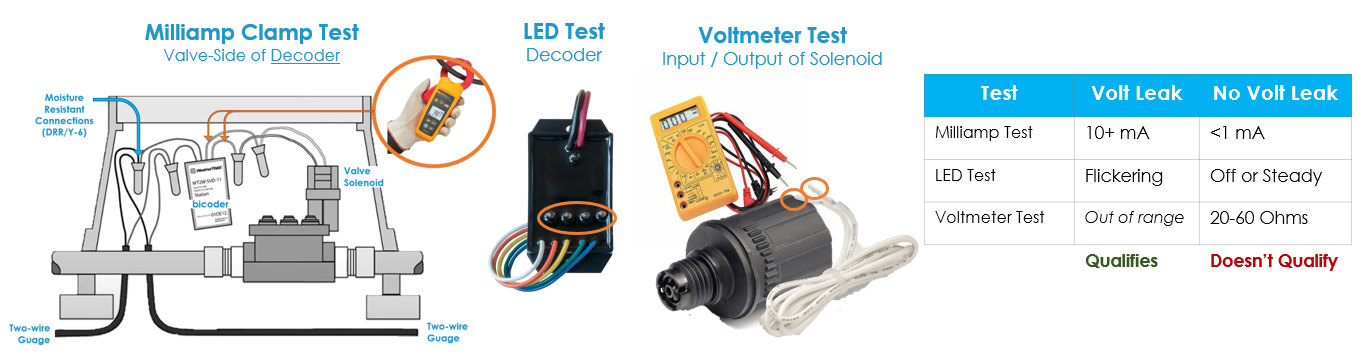
- Verify volt leakage.
- Check amperage on the valve side of the decoder using a Leaking Current Clamp Meter (milliamp reader). Valve side is orange and white wires connecting the decoder and the solenoid.
- If milliamp reader shows amperage = indicates voltage leak, qualifies for replacement.
- Ask what LED on valve side of the decoder is doing? (if no milliamp reader)
- If LED light is flickering (16V for light to flicker) = indicates voltage leak, qualifies. (Note: If zone actively running, LED light would be steady) If zone is not powered on and the light still flickers there could be a path to ground present.
- Watch min 9 of How To Troubleshoot WeatherTRAK 2 Wire - YouTube to understand how a milliamp works. (Video differs because the clamp needs to be placed between the decoder and the solenoid, not on the two wire gauges.)
- Check amperage on the valve side of the decoder using a Leaking Current Clamp Meter (milliamp reader). Valve side is orange and white wires connecting the decoder and the solenoid.
- If circumstances do not qualify, apologize, explain not within warranty. Instruct customer to purchase new solenoid and explain the decoder is likely fully operational regardless of solenoid issue.
- If the circumstances qualify, Issue RMA to replace decoder and have customer purchase replacement solenoid. Instruct customer to send you back the impaired solenoid and decoder for analysis.
Approved Support Script Messaging:
Customer: “I have x solenoids broken. I’ve heard your decoders are frying/ damaging my solenoids. I’m requesting free decoder replacements.”
Approved Explanation
Support: “We are very sorry to hear you are experiencing difficulties. We are aware of this issue and the perception that our decoders are at fault for premature solenoid failure. However, our decoders do not apply enough electricity to the solenoid to cause such failures. In all the cases we've indicated, as well as the general architecture of our system, the reason why your solenoids are failing is because there was a bad splice at the time of installation. The most likely reason is that an extra tool was used to push the wire nut into the end of the DBRY-6 casing creating a cavity in the dielectric gel which allowed water to gain access into the wire connection on the valve side of the decoder. Improperly sealed connections expose wire to water, oxidation and corrosion, causing premature failures in the solenoid. The solenoid was likely operational intermittently when the water dried. We discovered recent problems are likely from solenoids with bare copper wire instead of tinned wire, which we've found one of the large solenoid manufacturers to have switched to. It is industry best practice for irrigation applications to use tinned wire because it does not easily oxidize/ corrode in wet/ contaminated environments. I can send you a leaflet for best splicing practices. On the bright side, almost all the decoders that were sent back to us were not affected by bad solenoids, because they have a FET that protects the internal components from over current. In fact we added an additional FET to the Single Decoders (our Dual and Quad decoders already included two) to reduce the possibility of current leakage to the solenoid when a compromised splice is present. FETs also serves as a protective disconnect for our decoders to not draw too much current. It's very likely the system will not issue related alters once that solenoid is replaced. We can make a note in your account of this issue, and you can always call back if the problem persists. Did you still want to go ahead with the process to see if this instance qualifies for a decoder replacement? I should note the process will require you to send a photo of the DBRY connections (with caps open) of the station and troubleshooting will require a Leaking Current Clamp Meter and maybe a voltmeter."
If maintainer only has a voltmeter, then the solenoid would need to be cut out to check if it's a solenoid side problem.
Approved Conclusion
If do not Qualify: “We are very sorry you did not qualify for a free replacement, we understand replacing these parts can be expensive and diagnosing and replacing this issue has consumed much of your time. We're sorry we are unable to alleviate the pain and frustration of this situation. Again, I would like to restate that the quality of the decoder was likely unaffected by the bad wire connection and will probably resume standard operation once that solenoid is replaced. We will log this instance into our system and hope you reach out to us if the issue persists."
“We recommend that if the solenoid brand/model does in fact use bare copper to call the manufacturer to see if he/she will replace this part for free, especially if it's before warranty. Also use the spec sheet on our website to confirm the solenoid is compatible with our two-wire system.”
If Qualify "We apologize for the trouble this issue has caused and for the failure of the decoder. We will send you a new one on our behalf. Please confirm this is the best address [__]. I wanted to mention that, with the free replacement, it's our policy to have you ship back the broken decoder/ solenoid so we our engineering team can further investigate this issue. We will not withhold the shipment of the replacement decoder as we know the station will be offline until the repair is made. Thank you so much for helping diagnosis and troubleshoot this issue.”
Example Images:
Policy for Replacing Product/Inventory
If unsure Consult Tier 2. Tier 2 should consult tier 3 to validate the correct troubleshooting and information has been gathered. Tier 3 should consult sales and support team leadership if unsure how to proceed and believe suitable for decoder replacement.
Channel Partners
- Please send those requests to Charles Zaher & Chris Manchuck for WeatherTrak or Chris Manchuck & Chris Wright for Baseline.
Previous Communications sent from Product Team
Re: HydroPoint single valve decoder update November 29, 2022
Dear customer,
Thank you for being a great partner and for working so closely with us. HydroPoint is always working to innovate and to efficiently scale our technologies as more and more customers bring HydroPoint to their sites. As part of our efforts to scale, HydroPoint is standardizing our decoder platforms so that the single valve decoder, dual valve decoder, and quad valve decoder all share the same hardware and firmware.
We would like to supply you with our standardized single valve decoders to work toward further optimizing your HydroPoint experience. We will send you the updated decoders at no cost and ask that you simply return your current single valve decoders to us. Our Sales and Support teams will coordinate the decoder replacement logistics to move the process forward.
Thank you!
Sincerely,
Bob Beers
Senior Product Manager, Smart Irrigation Technology, HydroPoint
208-639-8378 | bbeers@hydropoint.com
Re: HydroPoint decoder compatibility with irrigation valve solenoids November 29, 2022
HydroPoint decoders are engineered to have extremely low failure rates (less than 0.01%) which has been proven across more than 300,000 valve decoders that have been successfully installed and operational coast-to-coast and internationally for more than a decade. The decoders provide optimal system performance when installed correctly and to specification.
To provide full visibility into our decoder technology HydroPoint engaged an independent engineering firm to evaluate how a HydroPoint decoder energizes a solenoid. The independent firm also measured the in-rush and holding current for a conventional wire system as a point of comparison. Based on the results from the engineering firm, the total current passing through a solenoid controlled by HydroPoint decoder is only 120 milliamps, which is much less than the 219 milliamps of current drawn by solenoids on a conventional wire system.
Test Results
- In-rush current
- Holding current:
- The test results from the independent firm indicated HydroPoint decoders draw significantly less current than a conventional wire driven solenoid.
There are many factors that can contribute to a solenoid failing. A couple factors could include compromised wire connections between the decoder and the solenoid or with a solenoid that has already exhibited signs of failure (cracking, corrosion). A possible cause of solenoid failure when a solenoid is already compromised is due to voltage leakage passing through the decoder and the solenoid when there is a path to ground. We have tested multiple decoder technologies beyond HydroPoint decoders and found some voltage leakage when solenoid wires are exposed to earth ground in every instance.
While we feel very confident in our technology, we are always working to improve customer experience. Our engineering team is investigating ways to enhance our decoder technology to provide optimal system performance even when there are poor splices and best practices are not followed.
Sincerely,
Bob Beers
Senior Product Manager, Smart Irrigation Technology, HydroPoint
208-639-8378 | bbeers@hydropoint.com
Es
O