
Basic Call Handling and Process Flow
Purpose
This document is intended to provide an overview of the general call handling process flow for Customer Support team members. This is to be used by all Customer Support Specialists working in the Call Center.
Support Goal
HydroPoint is the leader in smart water management solutions, helping companies to maximize water savings, reduce operating costs, minimize business risks, and achieve sustainability goals. Our mission is to make the best and most efficient use of our world's most important resource.
The goal of the Customer Support team is to always focus on keeping our customer’s systems functioning efficiently, minimizing any downtime, and providing swift and comprehensive response and resolution to address any outages or system failures.
Talk Desk App "Ring groups"
Pro Support call group, activations call group, home owner call group, vip activations call group, vip pro support call group, watercompass call support group, baseline support group, spanish support call group, baseline spanish support group
General Call Handling Process
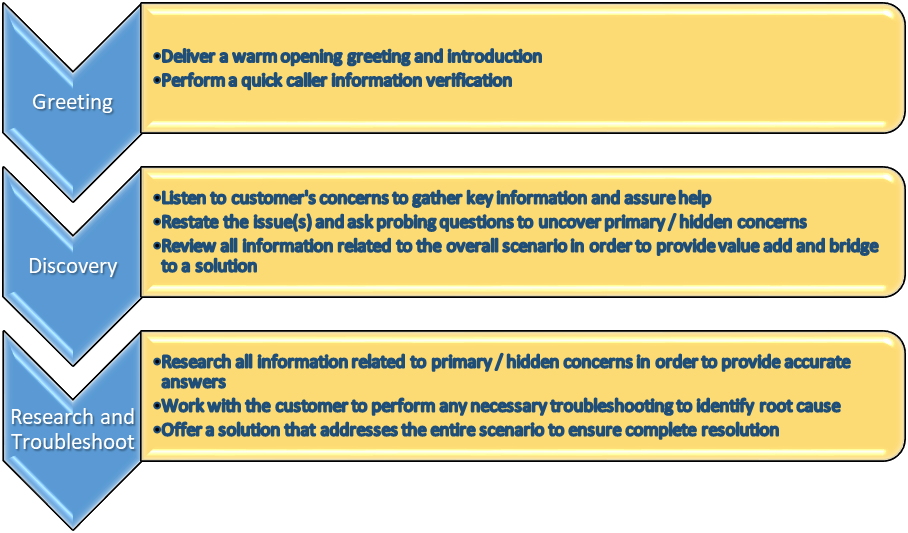
Greeting and Caller Information Verification – Deliver required introductory greeting and collect all necessary caller identifying information.
Discovery and Probing – Listen to customer’s concerns without interrupting and restate the issues to verify accuracy. Ask follow up probing questions as needed to uncover all issues and details before attempting to solve the problem. In the Irrigation Industry, it is important to discover and incorporate the contact's role and availability into our workflow so that we can strategize effectively.
Research and Troubleshooting – Look up and review all information needed to solve the customer’s problems before attempting to bridge to a solution. Keep the customer informed and involved during this step so that they know their issue is being addressed. Troubleshooting should be done following standard documented processes to ensure all steps are covered and documented properly.
Solution – Determine a resolution plan dictated by the customer’s issues only after fully probing, researching and troubleshooting the entire scenario. This solution should address all issues and any required follow up.
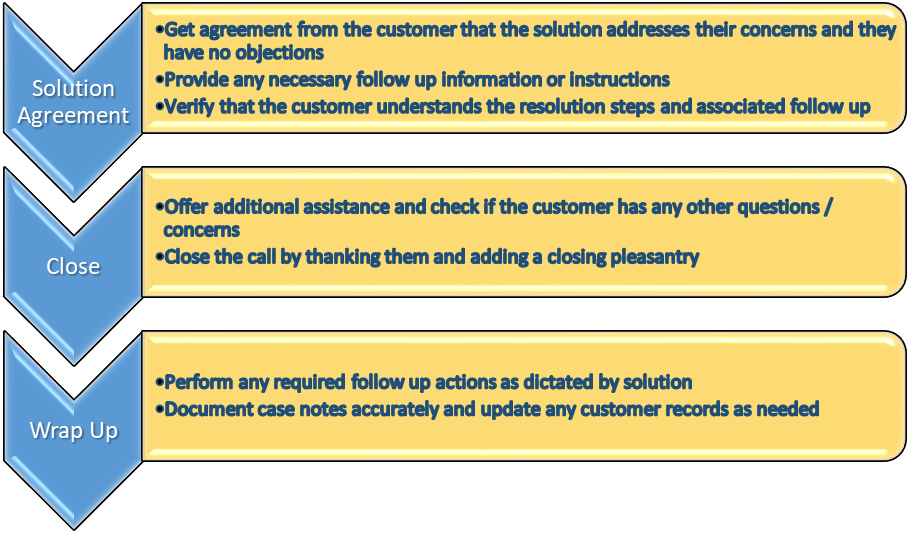
Agreement – Review resolution plan in a clear and concise manner to ensure the customer understands and agrees that the solution addresses their problem(s).
Closing and After-Call Wrap Up – Recap and review what was covered in the call and gain agreement. Deliver the required closing and verify there are no further questions or concerns from the customer. Document the case accurately for additional follow up or future reference
Call Flow Process
Opening Greeting Overview
When a customer calls in for support, agents should answer promptly and ready to assist. The opening greeting should be friendly and professional. Greet the caller, give the name of the company and introduce yourself before offering assistance. Be sure to obtain and/or verify the caller’s identifying information at the top of the call. Agents should follow the same basic framework for all calls to ensure consistency but may adapt using their own personal experience and best practices. Below are some examples of call greetings for new and existing contacts. Versions of this format can also be used for outbound calls, callbacks, returning missed calls, or voice mails.
Opening statement example (new contact inbound call):
1. Thank you for calling HydroPoint. This is (agent’s name).
2. May I please have your name, phone number, and email so I can contact you if we get disconnected?
3. Thank you (caller’s name). What can I help you with today?
Opening statement example (existing contact inbound call):
- Thank you for calling HydroPoint. This is (agent’s name).
- Am I speaking with (caller’s name)?
- May I please verify we still have your current phone number and email so I can update our records or contact you if we get disconnected?
- Thank you (caller’s name). What can I help you with today?
Opening statement example (existing contact outbound call or callback):
- Hello, this is (agent’s name) from HydroPoint returning your call.
- May I speak with (caller’s name)?
- May I please verify we still have your current phone number and email so I can update our records or contact you if we get disconnected?
- Thank you (caller’s name). What can I help you with today?
Discovery Overview
- Listen to customer's concerns without interruption to gather key information and details of their problem. In cases where the customer is upset, let them state their case and reassure them that you will help. Once a customer feels like they have been heard and are being supported, they are more likely to calm down and be easier to work with.
- Restate the issue(s) and verify understanding of the issue. Ask probing or follow-up questions to uncover primary / hidden concerns and any details that are still unclear. It is imperative that the contact understands how their site and controller is or should be configured in order for us to properly address potential technical issues.
- Review all information related to the overall scenario in order to provide any added value and bridge to a solution. This can include but is not limited to when they can or cannot be on-site for physical troubleshooting needs, if their role is suited for troubleshooting, additional related support case history, and any other team members or stakeholders who should be involved.
Research and Troubleshooting Overview
- Research all the information related to a caller’s primary / hidden concerns in order to provide accurate answers. Use the info we gathered on how their site and controller is or should be configured in order for us to properly address potential technical issues.
- Work with the customer to perform any troubleshooting necessary to identify root cause. This should be done following the standard documented support processes and procedures. In most cases, this will require knowledge of the specific site deployment and an onsite contact able to perform testing. If the caller is not onsite and troubleshooting requires an onsite contact, it may be necessary to schedule a call back or follow-up appointment. Be sure this is clearly documented in the case notes and that any alternate contact information is obtained for follow-up. Other specialists may need to pick up where you left off and vice versa on any given day.
- After researching and troubleshooting, identify a solution that addresses the entire scenario to ensure complete resolution of root cause issues.
Solution Agreement Overview
- Review the proposed solution with the caller and get agreement from them that the solution addresses their concerns. Give them the opportunity to ask any questions and verify that they have no objections.
- Provide any necessary follow up information or instructions that may be needed. Also be sure to clearly set proper expectations for next steps so there is no confusion or misunderstanding.
- Verify that the customer understands the resolution steps and any associated follow up. Any supplemental training or instructional materials should also be communicated in an agreed upon method.
Closing Call Overview
Once the problem has been effectively resolved, the agent should ask if there is anything else that the customer would like assistance with and ensure there are no further questions. Be sure that you have the correct contact info should any follow up be required. Be sure the caller has our contact information, thank them for calling, restate the company name, and then politely sign off. Similar to the opening greeting, this should be done in a friendly and professional manner. The customer is hopefully satisfied at this point and will likely be eager to bring the call to a close. Again, as with the opening greeting, agents should follow the same basic framework for all calls to ensure consistency, but may adapt using their own personal experience and best practices. Below is an example of a call closing.
Closing statement example:
- Today we covered __________ and did __________, Does this sound correct and make sense?
- Do you have any additional questions or concerns?
- Please remember you can reach us again via phone or email us at support@hydropoint.com if you have any other questions.
- Thank you for calling HydroPoint (caller’s name), and enjoy the rest of your day.
Wrap Up Overview
The wrap up, or after call work, is when all necessary case documentation should be verified. Additionally, if any follow-up action is required, this should also be documented within the case and set with the necessary reminders. This is also the time to send any email communications or updates and begin processing any additional requests (returns, orders, approvals, etc.). Finally, be sure to update any customer records as needed based on the information obtained in during the call.
- Perform any required follow up actions as dictated by the solution plan.
- Document case notes accurately and update any customer records as needed.