
What is Two-Wire
Two-wire Irrigation systems are the newest innovation in the irrigation industry. Despite the name, two-wire systems use significantly less wire overall.
In a two-wire site, a single cable runs the length of your site. Within this cable there are two wires that your irrigation devices connect to using decoders. These decoders can interpret the signals from the wires to control your stations.
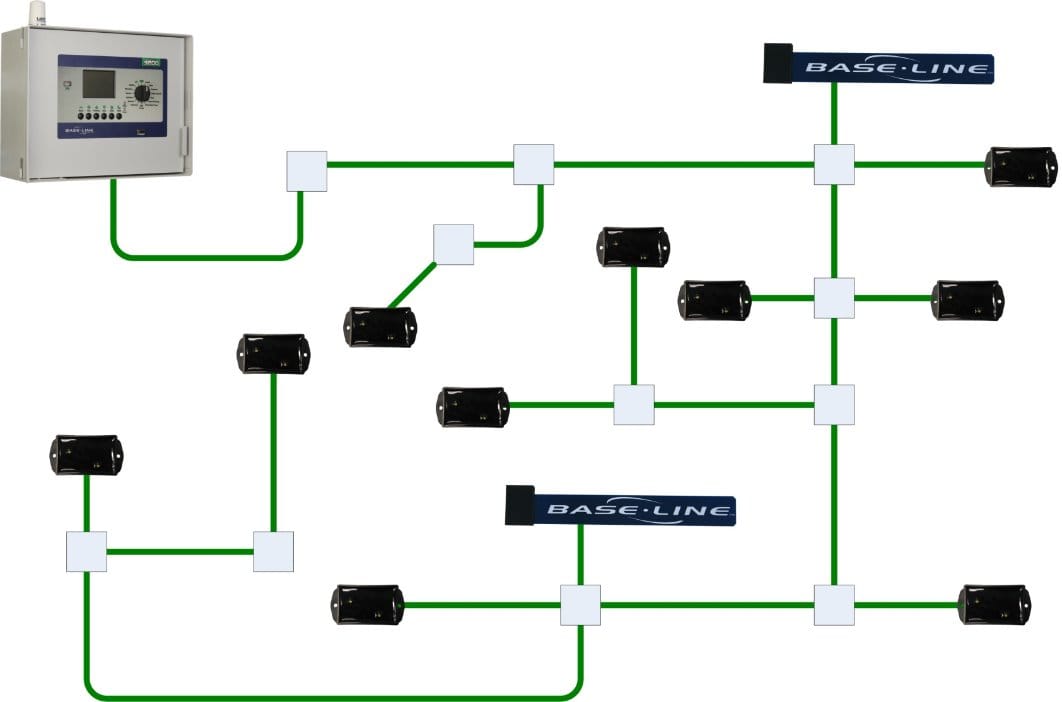
Pictured above is an example of a two-wire site. Note that each decoder, the black boxes, typically controls one or more stations. Other devices, like the blue soil moisture sensors, are also connected to the wire path.
You can think of the difference between a two-wire and conventional wire system like a city that uses a central highway versus a city that uses lots of backroads. Two-wire systems all depend on a central route with “exits” that branch out to each individual destination. Conventionally wired systems have a path to each destination, where the paths often overlap.
If you have spent enough time in traffic, you may realize that both of these approaches have their benefits and drawbacks. A central route is cheaper to install and more efficient, but a break can disrupt things further down the path. Having different routes means that if one goes down the others are unaffected, but requires a lot more resources to install.
When to Use Two-Wire
Two-wire systems are ideal for large sites where the cost of running multiple conventional wire paths would be complicated and expensive. For instance, a conventional 200-station site will experience significantly higher trenching, material, and programming costs compared to a two-wire system. Two-wire systems also generally allow for more stations to be controller per controller.
Two-wire systems also are ideal for sites where there is potential for expansion. When adding a station or device to a two-wire system, you simply add a new decoder to the existing two-wire path. This is especially useful for sites where trenching a new wire path could disrupt the site, such as hardscaped locations.
When Not to Use Two-Wire
For smaller sites, two-wire systems may be excessive. Decoders are significantly more expensive than wire, so sites with less distance between stations and the controller may not see the cost benefits of a two-wire system.
Two-wire systems also require more experience to troubleshoot. While a properly trained irrigation technician can troubleshoot two-wire systems faster than a conventional system, new users may struggle to understand the system. This very issue is why this article was created, and why we recommend you thoroughly read the next section.
Troubleshooting Two-Wire
Finding the Issue
To check what is wrong with your system, begin by checking the controller for alerts. Once you have found an alert, click here and navigate to the article related to your alert. If you cannot find a relevant article, search the KnowledgeBase for the alert using the searchbar. If you want to read an overview of the most common troubleshooting techniques and when to use them, read the “General Overview" section of this article.
Important Note
The most common cause of 2-wire system failures is improper electrical connections or grounding. When troubleshooting your system, ensure that all splices use DBRY-6 connectors and have been correctly installed. You can learn about how to properly use a DBRY-6 connection here. Additionally, make sure that the site has enough surge protectors for your configuration, and that all surge protectors have not been blown. You can learn more about proper surge arrestor installation here.
General Overview
Bicoder issues
If you suspect that a specific bicoder is malfunctioning, you can test it using the BaseManager app or your controller. This process is most commonly used when a station or group of stations that uses a bicoder is not working as expected, but the remainder of the two-wire path is still operable. You can learn about how to test your bicoders here.
System-Wide Issues
When a two-wire system encounters electrical issues that impact the entire two-wire path, such as an overcurrent alert, you will need to systematically test the two-wire path to find the issue. We recommend that you use a milliamp clamp meter to do this process. You can see an overview of the system testing methods below.
The Easy Way: use a milliamp clamp meter, examples include:
- BK Precision 316 (BL-BKCM)
- Armada Pro 93
The Hard Way: break connections at valve boxes/decoders to find the jump in current.
- A note about breaking connections: If you do not have a clamp meter, you can manually break the 2-wire connections systematically to isolate the wire segment or device that is generating the Over-Current message. This method is effective, but costs more and takes longer.
Other Issues
If you have an issue with your two-wire system that is less common, it is important that you troubleshoot it using the correct technique. Click the link below and select the issue that you are having. If your issue is not listed, we recommend searching the KnowledgeBase using the searchbar before calling support.